Friday, October 30, 2015

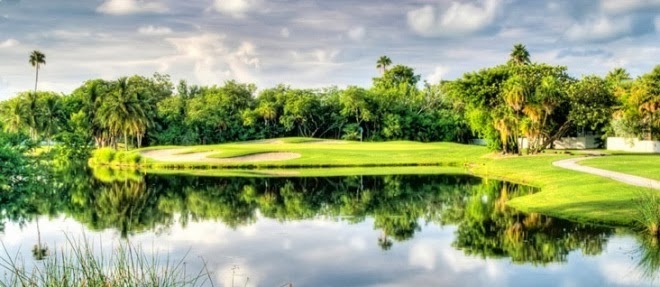
Key Colony Beach Golf Course


Info

Key Colony Beach Golf Course
Public (Municipal) - 9 Holes Executive
460 8th Street
Key Colony Beach, Florida
Monroe County
33051
Website


Logo


Award for Best Picture

VacationRentalsFloridaKeys.com


Notes

The visionary of the Key Colony Beach Golf Course was Phil Sadowski, 1958.

There have been 3 unique layouts for the course.

January, 1959 to 1968: Key Colony Beach Golf Club - 18 holes, par 54, 1293 yds, designed by Phil Sadowski. (estimated)

Around 1968 the golf course was reduced to 9 holes. (estimated)

1968-1980: Key Colony Beach Golf Club - 9 holes, par 27, 680 yds. (estimated)

Around 1980 the golf course was renamed and redesigned by Wayne Spano. (estimated)

Since 1980: Key Colony Beach Golf Course - 9 holes, par 27, 962 yds.


Video


Course Area


Layout and Scorecard


Street View of Clubhouse


Google Maps


Bing Maps


History

In 1957, Phil Sadowski was building Key Colony Beach by hauling, pumping, channeling, building roads, and created motels, apartments, and houses. He began to build a golf course. He had spent $6,500,000 creating Key Colony Beach.

In 1958, it is reported that a 18 hole golf course is still under construction and will be completed and ready for use in January 1959.

In 1959, it is noted the the course is one of the finest par three courses in the nation and that it is a complete 18-hole course. It was reported that the whole project had to dredged, sodded, fertilized, re-sodded, scraped, planted and watered. It was reported as the Key Colony Beach Golf Course. As shown in this April 1959 picture by Johnson, the sign shows it was officially known as Key Colony Beach Golf Club:


Here is another Johnson picture from April 1959 showing the golf course:


In this aerial picture of Key Colony Beach from 1960 you can see the golf course. It is roughly in the same footprint as the current golf course.


Using a large amount of poetic license, here is an estimated layout and scorecard of the Key Colony Beach Golf Club in 1959:


On September 9, 1960, Hurricane Donna destroyed a lot of Key Colony Beach. It is reported in December that the recovery is well on its way.

In 1961, Phil Sadowski places an ad to sell the course. It is described as 18 holes, 3 par, golf course in beautiful shape.

The course is still reported as an 18-hole course up to 1965.

In 1970, it is reported as a 9 hole par 3 course.

So somewhere, between 1965 to 1970, the course's footprint changed from 18 to 9 holes. Hurricane Betsy in 1965 and Hurricane Inez in 1966 may have played a part, or maybe the land was needed for other uses.

Key Colony Beach Golf Club Inc. was incorporated on April 10, 1968.

So I will estimate that the course was reduced to 9 holes in 1968. I will also estimate that is when the City of Key Colony Beach took over ownership of the golf course.

Based on an aerial from 1970, the scorecard and layout of the Key Colony Beach Golf Club in 1968 was:


In 1971, it is reported as the New Key Colony Beach Golf Club.

It was reported that the first full year of business for Key Colony Beach Par-3 is 1974. Along the way it is also called KCB Par-3. It states the course measures 962 yards. 1974 also marks the first year the Spano family manages the course. Wayne Spano has been credited by many as the designer of the course. The company KCB Island Par 3 starts in 1974. KCB Island Par 3 leases the golf course from the City of Key Colony Beach until 2009, upon the death of Mary Spano.

Here is an aerial photo by Tom McLendon from 1977 which shows the golf course on the right side.


This picture from 1977 confirms that the 1968 layout is still in place.

It was reported that the course opened in 1980, and therefore I believe this is when the course was redesigned by Wayne Spano to its current configuration.

On April 20, 1996, a golfer records double holes-in-one on the same day on the same hole - hole 4 - at Key Colony Beach Golf Course.


Florida Keys Country Club


Info

Florida Keys Country Club
Public - 18 holes
4000 Sombrero Boulevard
Marathon, Florida
Monroe County
33050
Website


Logo


Award for Best Picture

YouTube


Notes

The visionary of the Florida Keys Country Club was Stanley Switlik, 1952.

The Florida Keys Golf Course has had 5 unique layouts:

January 16, 1960-1966: Sombrero Yacht and Golf Club - 18 holes, par 71, 6303 yds, designed by Mark Mahannah.

In 1966 the course was renamed the Sombrero Country Club.

1966-2002: Sombrero Country Club - 18 holes, par 71, 6303 yds.
2002-2007: Sombrero Country Club - 18 holes, par 71, 6469 yds.
2007 to May 31, 2013: Sombrero Country Club - 18 holes, par 72, 6087 yds.

On June 1, 2013 the course was renamed the Florida Keys Country Club.

Since June 1, 2013: Florida Keys Country Club - 18 holes, par 72, 6087 yds.

In the near future, it will be known as the Florida Keys Resort.


Video


Course Area


Course Layout


Scorecard


Street View of Clubhouse


Google Maps


Bing Maps


History

Stanley Switlik, an industrialist from New Jersey, visited the Marathon area while on vacation in 1952. He started buying land. In 1955 he started to develop the area by clearing land, dredging and pumping to creat canals and a lagoon. Switlik hired Mark Mahannah to design the course and in 1956 construction started on the golf course. He used fill to create the land for the golf course area. One reporter stated "The 18-hole layout has been brought out of the Atlantic".

The clubhouse was built in 1956.

The grand opening of the club was on January 16, 1960. It operated as a private club but was open to the public.

It was known as the Sombrero Yacht and Golf Club. The word 'Sombrero' comes from the name of the lighthouse that was erected on the nearby reef before the Civil War.

During the early years, it was also reported as:
Sombrero Yacht and Country Club
Sombrero Key Golf Course
Sombrero Key Country Club
Sombrero Golf and Country Club
Sombrero County Club

The course covered 135 acres, measured 6,303 yards, and played to a par 71.

In 1964, Switlik offered to sell the club to the county for use as a public park but was denied.

In 1966, Switlik sold the club to a group of members and residents for $250,000. He had spent around $4,000,000. The group renamed the new club the Sombrero Country Club.


Why an owl in the logo? Burrowing owls nest in the fairway trees.

During the 1970's the private club had around 280 members.

On September 25, 1998, Hurricane Georges virtually decimated the golf course. The course appeared more open since the hurricane took out more than 300 trees.

It took around 4 years to rebuild the course. At this time, I believe the course's yardage changed to 6,469 yards.


In 2003 the membership numbers were still strong and above 200 members.

In a 2006/2007 renovation, the course was reduced to 6,087 yards but raised to a par 72. The same layout stayed in place with small changes in green shapes and bunkers. On 15 holes, the back tees were removed which shortened these holes and accounted for the yardage reduction. Only 1 hole, #3, was lengthened, by 66 yards, and changed from a par 4 to a par 5.


In 2010, it was noted that water spilled onto the golf course during exceptionally high tides. The club put berms in to keep the salt water out and the fresh water in. The club's driving range is almost devoid of grass because of damage from previous floods.

Also in 2010, due to declining membership, now at 69 members, the club started considering a massive redevelopment into a destination resort to keep it afloat. A club member noted that it's apparent a private-club business model wasn't viable in Marathon any longer. This plan called for a golf course redesign by Jim Fazio.


Sombrero Country Club officially changed their name to Florida Keys Country Club on June 1, 2013. The main reason for the name change was an effort to maximize exposure of the golf course via the internet and social media to gain members and create a new image.

In September 2013, with membership down to 49, a group of investors proposed another plan to the club, and the members unanimously accepted the offer. The city of Marathon said any project that would improve the golf course would be good for Marathon’s economy.

In July 2014, the City of Marathon approved the plan under the stipulation that the public have access to the golf course.

In January 2015,  the Florida Keys Country Club was sold for $4,375,000 to the Florida Keys Resort.

Florida Keys Resort plans on a $60-million renovation which may include tennis courts, a pool, a restaurant, cottages, a marina and a hotel.

Regarding the golf facilities, a new clubhouse, a new pro shop and a course overhaul are planned. The golf course design to be created by Kip Schulties at 6,600 yards. One of the biggest changes for the golf course will be to raise the front nine, or east, holes which are prone to flooding. When the original course was built, the crew ran out of fill removed from the nearby canals, which led to those holes being 20 inches lower than the back 9 holes.

Construction overall is expected to take several years and will be called Florida Keys Resort when it is complete.

Key West Golf Club


Info

Key West Golf Club
Public - 18 Holes
6450 East College Road
Key West, Florida
Monroe County
33040
Website


Logo


Award for Best Picture

KeyWestGolf.com (the 16th hole)


Notes

The visionaries of the Key West Golf and Country Club were The Key West Chamber of Commerce, 1923.

Over its history, there have been 3 unique course layouts:

1924 to 1966: Key West Golf and Country Club - 9 holes, par 35, 3160 yds and was designed by Langford & Moreau.

In 1966, an additional 9 holes were added and were designed by Mark Mahannah.

1966 to 1982: Key West Country Club - 18 holes, par 70, 6111 yds (estimated).

In 1983 the course was totally redesigned by Rees Jones and Keith Evans.

Since 1983: Key West Golf Club - 18 holes, par 70, 6531 yds.

The Key West Golf Club is the southernmost golf course in the continental United States and calls itself the only Caribbean course in the US.


Course Area


The homes within the golf course boundary are part of 2 gated communities - The Key West Golf Club and The Santuary.


Course Layout


Scorecard


Street View of Entrance


Google Maps


Bing Maps


History

In April 1923, a contract was drawn up for plans for a 18-hole golf course on Stock Island between the Key West Chamber of Commerce and Langford & Moreau, golf architects, of Chicago. A bond election held on May 10, 1923 passed and $150,000 was raised to purchase the lands and construct the course. On land described as ‘flatter than a pancake,’ Langford and Moreau designed a spectacular layout which included an island green and a tee out in the Gulf of Mexico. The course was to be 18 holes, par 71, 6305 yards. The plans were ready by the bond election and are shown below.


http://i1211.photobucket.com/albums/cc435/snilsen7/KeyWest_zps27d4b5c1.png~original

Work began immediately after the bond election, with the intention of having the course ready for 1923-24 winter season. William B. 'Billy' Langford and Theodore J. Moreau supervised the construction and ran into difficulties in building the course. First, they had to use dynamite to blast away at the island's coral rock formation. Secondly, 30% of the island was under water at high tide. Therefore the 1st 9 holes were constructed on land out of the water. To build the other 9 holes would require bulkheads and fill at an additional cost of $210,000.

Work progressed on the course, and when 6 holes were completed in early 1924, it was opened to the public for free until the other 3 holes were built by the summer of 1924. The clubhouse was constructed on the gulf side of the island. It was decided that the other 9 holes would be built at a later time.

The following aerial snippet from 1941 shows the 9-hole golf course:


When I compare this 1941 aerial to the Langford & Moreau plan of 1923 (shown above), it matches up exceedingly well for the planned holes 1 through 9. As a result, using the 1923 plan, the 9-hole course would have had a layout and scorecard like this:


In 1928, the Miami News referred to the course as the Key West Golf and Country Club.

Key West was once the richest city in the United States in terms of per capita income but on July 1, 1934, the city declared bankruptcy and State of Florida ran the city.

Times were tough for Key West until later in the year when the Federal Government under the New Deal's Federal Emergency Relief Administration (FERA) created by the newly elected President Franklin D. Roosevelt pumped money into Key West. Julius Stone, Jr., the administrator for FERA for Key West, decided that since Key West had lost most of its industries to other cities, that the best course of action would be to create Key West into a tourist mecca.

On September 2, 1935 the category 5 Labor Day Hurricane hit Key West with 185 mph winds. At the time, it was the strongest hurricane ever to hit the US. Henry Flagler's Florida East Railroad was the only link to the mainland, but it was destroyed in several sections, and as a result the railroad line in the Keys was never rebuilt.

As part of his FERA plan for Key West, Stone decided to rebuild the golf course and $18,722 were allocated to recondition the municipal golf course. The following picture entitled "Municipal golf course built by the FERA - Key West, Florida" from 1935, shows 6 ladies watching a golfer on the rebuilt golf course.


After the railroad's demise, Key West was linked to mainland again by the opening the famed Overseas Highway in 1938. By January, 1939, the golf course had been practically rebuilt including all the greens.

In 1947, badly needed repairs to the greens were approved by the City of Key West.

In 1948, Key West Golf Club signed a 20 year land lease with the City of Key West for their new clubhouse.

President Truman would golf here in the late 40's and early 50's but made his 1952 trip his last excursion to Key West to golf since the course was no longer good enough for him.

The City of Key West approved plans for an addition of 9 holes to the municipal golf course in July, 1956.

By 1960, the members of the Key West Golf Club were fed up with the condition of the golf course and demanded that the city bring the course up to a full 18 holes and that the old 9 holes be plowed up and replanted. The course, at this time, had only light grass topping covering the crushed coral rock base called marl. It was planned that the rebuilding process was to take about 30 months and was to be completed in the summer of 1962.

In April 1961, Sam Golan who headed the Key West Golf Club hired Mark Mahannah as the architect to bring the course up to 18 holes. At this time, the Key West Golf Club is reported to be a private club.

Since topsoil was very expensive to import into Key West, 'Keys peat moss', a rich fertile black soil found underneath the roots of abundant and nearby mangrove swamps was to be used in place of traditional topsoil.

However, the city had to sue the contractor for breach of contract thus delaying the opening of the additional 9 holes.

In May, 1964, the new Key West Country Club was deciding between 2 possible building sites for its new clubhouse.

Images from 1965 show that most of the new 9 holes were still not completed but I will assume that construction was complete by 1966.

Pasting together 2 aerial pictures from Florida Memory from the 1970s, here is what the 18-hole golf course looked like in its completed form:


When this image is compared to the 1923 plan, the additional 9 holes built did not follow the 1923 plan. It is obvious that Mark Mahannah retained the first 9 holes layout and yardages but left his mark by designing new layouts and yardages for the additional 9 holes.

It is a shame that hole 10 from 1923 plan was never built. Hole 10 was planned as a 340 yard par 4 with an island green.

Since the clubhouse was moved to the middle of the property, I assume the order of the front 9 changed with hole 9 becoming hole 1 and hole 1 becoming hole 2 and so forth.

Working off an 1970 aerial, here is an estimated scorecard and layout for the expanded Key West Golf Course.


A postcard from Florida Memory by photographer Avery Johnson:


In 1976, the City of Key West took over the Key West Golf Course.

In 1983, Rees Jones and Keith Evans did a new design of the course. When this new design is compared to the 1966 plan, not one hole from the 1966 plan was kept. The first 9 holes opened in April, 1983 and the second 9 holes opened in December, 1983. The new course was 6,531 yards long from the back tees and played to a par 70. It contained 51 bunkers. This was Rees Jones first design with his own firm. Most of the materials to build the course were shipped by barge from Homestead.

On October 24, 2005, Hurricane Wilma generated an eight-foot storm surge that flooded the Key West Golf Club with four feet of salt water and inundated the irrigation ponds with ocean water, leaving no source for fresh water. The course opened the next day, but a major course rebuild was required. Renovations on the front 9 holes began in June 2006 with new drainage, land raising, re-grassing greens and fairways amongst the repairs. The back 9 holes were reseeded in June 2007. The course reopened on October 1, 2007.

Thursday, October 24, 2013

Golf Courses - Florida - Multi-Course Facilities

Public | Resort-Public | Resort-Private | Private

M = Municipal
R = Resident
S = Semi-Private

The # of golf courses within a County are noted in parenthesis.


North West region: Bay | Calhoun | Escambia | Franklin | Gulf Holmes | Jackson | Liberty | Okaloosa | Santa Rosa | Walton | Washington

North Central region: Alachua | Bradford | Columbia | Dixie | Gadsden | Gilchrist | Hamilton | Jefferson | Lafayette | Leon | Levy | Madison | Suwannee | Taylor | Union | Wakulla

North East region: Baker | Clay | Duval | Nassau | Putnam | St. Johns

Central West region: Citrus | Hernando | Hillsborough | Pasco | Pinellas | Polk

Central East region: Brevard | Flagler | Lake | Marion | Orange | Osceola | Seminole | Sumter | Volusia

South West region: Charlotte | Collier | DeSoto | Glades | Hardee | Hendry | Highlands | Lee | Manatee | Sarasota

South East region: Broward [11] | Indian River | Martin | Miami-Dade [4] | Okeechobee | Palm Beach [36] | St. Lucie

South region: Monroe [1]


Golf Courses - Florida - 9-Hole Executive Courses

Public | Resort-Public | Resort-Private | Private

M = Municipal
R = Resident
S = Semi-Private

The # of golf courses within a County are noted in parenthesis.


North West region: Bay | Calhoun | Escambia | Franklin | Gulf Holmes | Jackson | Liberty | Okaloosa | Santa Rosa | Walton | Washington

North Central region: Alachua | Bradford | Columbia | Dixie | Gadsden | Gilchrist | Hamilton | Jefferson | Lafayette | Leon | Levy | Madison | Suwannee | Taylor | Union | Wakulla

North East region: Baker | Clay | Duval | Nassau | Putnam | St. Johns

Central West region: Citrus | Hernando | Hillsborough | Pasco | Pinellas | Polk

Central East region: Brevard | Flagler | Lake | Marion | Orange | Osceola | Seminole | Sumter | Volusia

South West region: Charlotte | Collier | DeSoto | Glades | Hardee | Hendry | Highlands | Lee | Manatee | Sarasota

South East region: Broward [7] | Indian River | Martin | Miami-Dade [1] | Okeechobee | Palm Beach [6] | St. Lucie

South region: Monroe [2]


Golf Courses - Florida - 9-Hole Courses

Public | Resort-Public | Resort-Private | Private

M = Municipal
R = Resident
S = Semi-Private

The # of golf courses within a County are noted in parenthesis.


North West region: Bay | Calhoun | Escambia | Franklin | Gulf Holmes | Jackson | Liberty | Okaloosa | Santa Rosa | Walton | Washington

North Central region: Alachua | Bradford | Columbia | Dixie | Gadsden | Gilchrist | Hamilton | Jefferson | Lafayette | Leon | Levy | Madison | Suwannee | Taylor | Union | Wakulla

North East region: Baker | Clay | Duval | Nassau | Putnam | St. Johns

Central West region: Citrus | Hernando | Hillsborough | Pasco | Pinellas | Polk

Central East region: Brevard | Flagler | Lake | Marion | Orange | Osceola | Seminole | Sumter | Volusia

South West region: Charlotte | Collier | DeSoto | Glades | Hardee | Hendry | Highlands | Lee | Manatee | Sarasota

South East region: Broward [3] | Indian River | Martin | Miami-Dade [6] | Okeechobee | Palm Beach [29] | St. Lucie

South region: Monroe [0]


Golf Courses - Florida - 18-Hole Executive Courses

Public | Resort-Public | Resort-Private | Private

M = Municipal
R = Resident
S = Semi-Private

The # of golf courses within a County are noted in parenthesis.


North West region: Bay | Calhoun | Escambia | Franklin | Gulf Holmes | Jackson | Liberty | Okaloosa | Santa Rosa | Walton | Washington

North Central region: Alachua | Bradford | Columbia | Dixie | Gadsden | Gilchrist | Hamilton | Jefferson | Lafayette | Leon | Levy | Madison | Suwannee | Taylor | Union | Wakulla

North East region: Baker | Clay | Duval | Nassau | Putnam | St. Johns

Central West region: Citrus | Hernando | Hillsborough | Pasco | Pinellas | Polk

Central East region: Brevard | Flagler | Lake | Marion | Orange | Osceola | Seminole | Sumter | Volusia

South West region: Charlotte | Collier | DeSoto | Glades | Hardee | Hendry | Highlands | Lee | Manatee | Sarasota

South East region: Broward [6] | Indian River | Martin | Miami-Dade [0] | Okeechobee | Palm Beach [14] | St. Lucie

South region: Monroe [0]